What discretion covers
In the public mind, a chauffeur's discretion comes down to not talking. It goes far beyond that. It concerns what the chauffeur sees: the people getting in and out, the places visited, the documents lying on the seat. It concerns what the chauffeur hears: calls, conversations, exchanges between passengers. And it concerns what he knows: schedules, addresses, habits. People and places are part of this, as is anything left in plain view inside the cabin.
Being discreet therefore means mastering these three dimensions consistently. It requires a posture, training and a clear framework, because improvised discretion is fragile. It is judged day to day, in simple gestures: commenting on nothing, relaying nothing, leaving nothing lying around. This is the meaning of IKIGAI's motto: Discipline, Diligence, Discretion. A chauffeur who keeps to this every day naturally inspires trust in those who entrust their journeys, and that consistency is felt from the very first rides. It cannot be faked.

Before the journey: information circulates as little as possible
Confidentiality starts at booking. The information provided, such as the passenger's identity, addresses and times, should be known only to those strictly needed for the assignment. Ideally the chauffeur receives only what is needed to do the job, at the moment it is needed, rather than a complete file. This need-to-know rule applies to internal exchanges as well: a message sent to too many recipients is already a potential leak, best avoided from the outset. Restraint at this stage protects the passenger throughout the day.
For a passenger whose name is sensitive, it is possible to agree on a neutral way of referring to them, for example a file reference rather than a full name in written exchanges. Assistants, family offices and concierge teams can then organise journeys without exposing their principals. Our guide for executive assistants explains how to write a discreet brief. Families staying in Paris can apply the same logic to relatives and guests.

During the journey: posture and driving
On board, discretion takes concrete form. The chauffeur starts a conversation only if the passenger wishes, lowers or switches off the music on request, does not look at screens and lets the passenger take calls without intervening. If conversation is welcome, the chauffeur stays measured and asks no personal questions. These courtesies adapt to each passenger and are never imposed. The passenger does not need to ask. Such small courtesies are the standard we hold ourselves to.
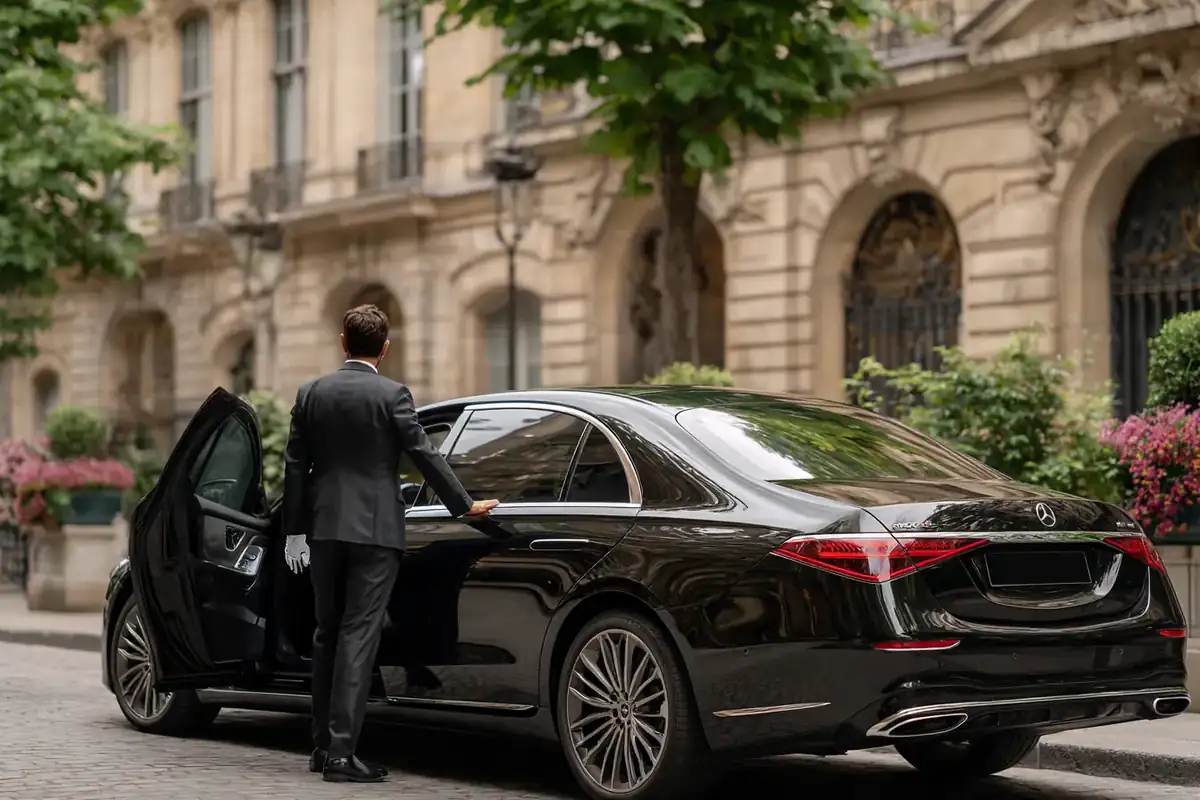
Driving itself contributes to this restraint: smooth trajectory, quiet arrival, punctuality, careful handling of drop-off points to limit the passenger's exposure. In busy public places, such as a hotel, a station or an event, the chauffeur anticipates the most discreet access and chooses the moment to open the door. These details make the difference. The passenger has nothing to request: everything is prepared in advance. This restraint is deliberate, not accidental.

After the journey: keep nothing, disclose nothing
Discretion does not end when the passenger leaves the vehicle. It means not speaking about the passenger to third parties, not posting photos or messages about them and keeping only the information strictly useful for invoicing or follow-up. The chauffeur takes away nothing of what has been seen or heard outside the assignment. Nothing about the passenger is shared, and nothing is kept beyond what the service requires. No photograph or document is retained.
Forgotten items, documents left on the seat or connected devices are treated with the same rigour: returned directly to the passenger or the designated person, without comment. This rule applies to everyone, whether the journey lasted a few minutes or a full day. It is a basic expectation of a premium service, and we remind every team of it. Each case is handled with care and recorded only as far as the follow-up requires.

Formalising it: a five-point protocol
Rather than relying on verbal commitments, it is better to write the rules down. A discretion protocol fits in a few lines and is shared with the chauffeur before the first journey. It states how the passenger is referred to, who may change the booking, what to do in case of the unexpected and how to handle items left behind. This written record also reassures the chauffeur, who knows exactly what is expected and can deliver it consistently, whatever the circumstances of the journey.
Discretion can be contractual: it then becomes the provider's commitment, set out in the terms of the service. For companies and family offices, this element often weighs as much as the vehicle in choosing a partner. You can discuss it when requesting a quote, which is firm before confirmation, by WhatsApp, e-mail or form. Each request is reviewed carefully before confirmation. Nothing is left implicit or open to interpretation by anyone involved.

What is reasonable to expect, and what belongs to other professions
It is also worth being precise about what discretion is not. A luxury chauffeur provides comfortable, confidential transport; the role does not extend to other functions. We promise only what we can deliver, and say so from the outset, so that each client chooses in full knowledge. Clarity on this point protects both parties and builds lasting trust, based on realistic commitments rather than general formulas. That is the principle we apply.
For a passenger who wants to compare service formats further, our guide on chauffeur service, taxi or ride-hailing sets out the practical differences. And if your needs involve highly exposed profiles, the VIP chauffeur service allows a suitable framework to be defined, with a single contact for the whole stay. In both cases, we remain available to talk it through. Describe your situation and we will suggest an appropriate framework.